Every day, people buy products, pay for services, use apps, visit restaurants, and shop online. Behind all of these activities is a business.
But what is a business, and how does it actually work?
In simple terms, a business is an activity or organization that provides products or services to customers in exchange for money or another form of value. A business may be operated by one person from home or by thousands of employees across multiple locations.
Businesses exist in almost every industry. They sell food, clothing, software, transportation, education, financial services, healthcare, entertainment, and much more.
Understanding how businesses work is useful whether you are a student, consumer, freelancer, entrepreneur, or someone thinking about starting a company.
What Is a Business?
A business is an organization or commercial activity that provides goods or services to customers in exchange for value, usually money.
For example:
- A restaurant sells prepared food.
- A clothing store sells apparel.
- A plumber provides repair services.
- A software company sells digital products.
- A freelancer provides professional services.
- An online store sells products through a website.
- A consulting firm provides expert advice.
The size of the operation does not determine whether it is a business.
A person working alone can operate a business just as a large corporation can. The main difference is the scale, resources, number of employees, and complexity of operations.
How Does a Business Work?
Although businesses can be very different, most follow a basic process.
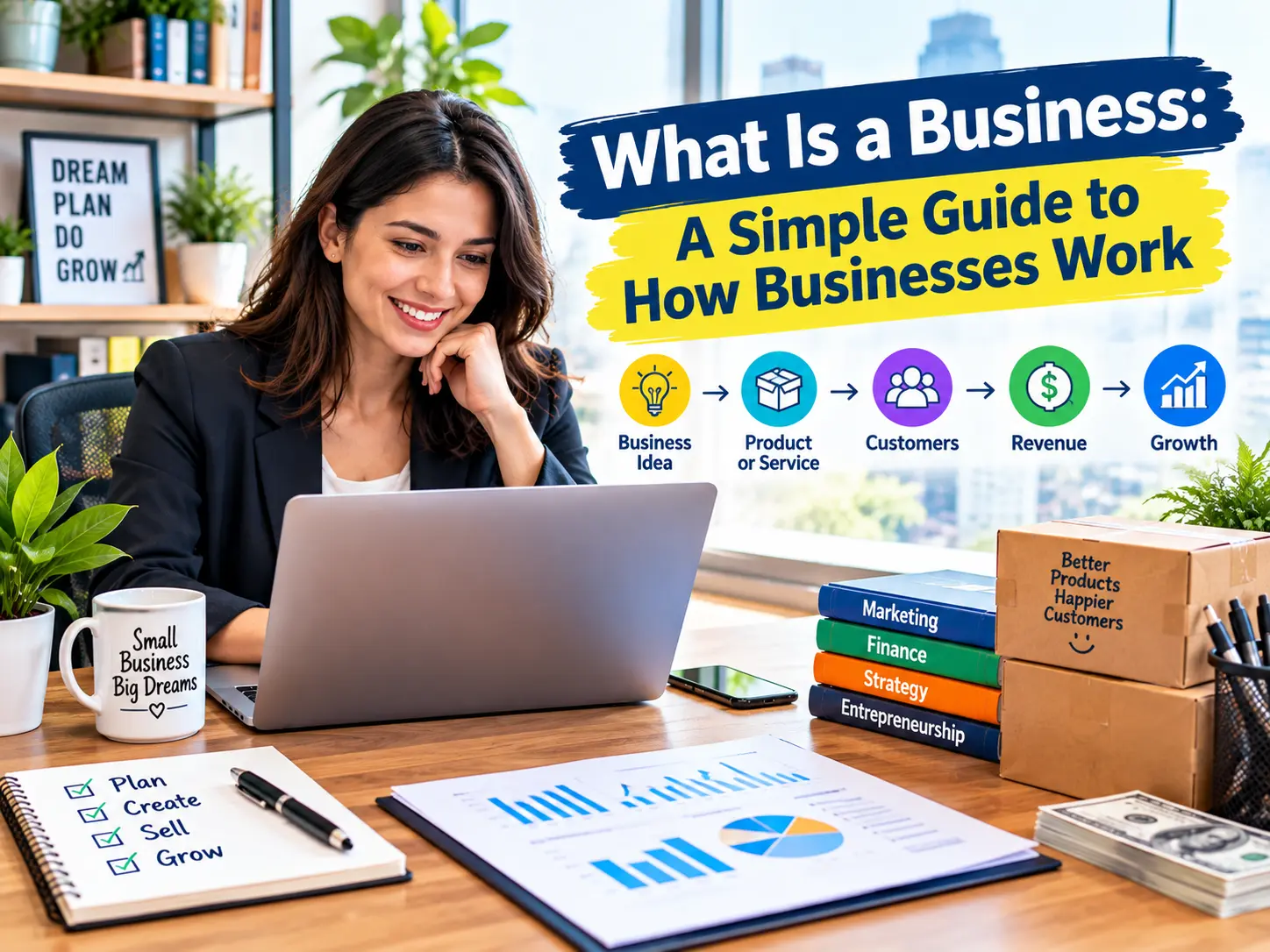
First, a business identifies a need or problem. It then creates a product or service that addresses that need. The business finds customers, sells its offer, delivers the product or service, and collects revenue.
At the same time, the business has expenses.
These expenses may include:
- Employee wages
- Inventory
- Rent
- Equipment
- Marketing
- Website and software costs
- Insurance
- Transportation
- Professional services
- Taxes and fees
The business needs to manage these costs carefully so that its revenue can support its operations and, ideally, produce a profit.
What Is the Purpose of a Business?
A business can have several purposes, depending on its owners and goals.
Solving Customer Problems
Many businesses begin with a simple idea: solve a problem for customers.
For example, a meal-delivery business makes it easier for busy people to get food without visiting a restaurant.
A bookkeeping service helps small businesses organize their financial records.
A software company may create a tool that saves employees time.
Providing Products or Services
Businesses make products and services available to people who need or want them.
Products can include physical items such as furniture, food, electronics, and clothing. Services can include consulting, transportation, cleaning, repairs, education, and design.
Generating Income
A commercial business generally needs to generate enough income to pay its expenses and continue operating.
If revenue consistently falls below expenses, the business may struggle to survive.
Creating Employment
Businesses also provide jobs.
A growing company may hire employees in sales, customer service, accounting, technology, management, production, and other areas.
What Is the Difference Between Revenue and Profit?
Revenue and profit are two business terms that are often confused.
Revenue is the money a business receives from selling its products or services.
Profit is the amount left after the business subtracts its expenses from its revenue.
For example, imagine an online store makes $20,000 in sales in one month.
The business spends $8,000 on inventory, $2,000 on advertising, $1,500 on shipping, and $3,000 on other operating expenses.
The business has $5,500 remaining before considering other applicable expenses and taxes.
This shows why high sales do not automatically mean high profits.
A business can generate significant revenue and still have a small profit if its operating costs are high.
What Are the Main Types of Businesses?
Businesses can be classified in different ways. One simple approach is to look at what they sell.
Product-Based Businesses
Product-based businesses sell physical or digital products.
Examples include:
- Grocery stores
- Clothing brands
- Furniture companies
- Electronics retailers
- Online stores
- Software companies
Some products are sold once, while others may generate repeat purchases.
Service-Based Businesses
Service businesses sell skills, labor, knowledge, or expertise.
Examples include:
- Accounting firms
- Marketing agencies
- Cleaning companies
- Law firms
- Consulting businesses
- Repair companies
- Freelancers
A service may be priced by the hour, project, subscription, or another arrangement.
Hybrid Businesses
Some businesses sell both products and services.
For example, a computer company may sell laptops while also providing repairs and technical support.
A fitness business may offer memberships, personal training, classes, and fitness products.
What Is an Online Business?
An online business uses the internet to sell products or provide services.
Common examples include:
- E-commerce stores
- Software companies
- Freelance businesses
- Online courses
- Digital marketing agencies
- Subscription websites
- Content businesses
An online business does not necessarily mean the business has no physical expenses. It may still need employees, equipment, software, advertising, inventory, and office space.
What Is a Local Business?
A local business mainly serves customers in a specific geographic area.
Examples include:
- Restaurants
- Hair salons
- Auto repair shops
- Dentists
- Plumbers
- Cleaning services
- Local retail stores
Many local businesses now use websites, social media, online reviews, and digital advertising to reach customers.
What Is a Business Model?
A business model explains how a business creates value and earns revenue.
Different companies can sell similar products while using different business models.
For example, one software company may charge customers a monthly subscription. Another may sell a software license for a one-time payment.
Common business models include:
Subscription Model
Customers pay regularly, often every month or year.
Direct Sales Model
The business sells products or services directly to customers.
Advertising Model
The business generates revenue by displaying advertising to its audience.
Marketplace Model
The business connects buyers and sellers and may charge fees for transactions.
Commission Model
The company receives a percentage or fee when a sale or transaction occurs.
Freemium Model
Customers can use a basic version for free, while advanced features require payment.
What Are Common Business Structures in the United States?
If you want to start a business in the United States, choosing a legal structure is an important decision.
Common structures include:
- Sole proprietorship
- Partnership
- Limited liability company (LLC)
- Corporation
Each structure can have different legal, tax, ownership, and administrative consequences.
Sole Proprietorship
A sole proprietorship is an unincorporated business owned and operated by one person.
It is generally simple to operate, but the owner and business are not separate legal entities in the same way as a corporation.
Partnership
A partnership generally involves two or more people operating a business together.
Partners may share profits, responsibilities, and business obligations according to their agreement and applicable law.
Limited Liability Company
An LLC, or limited liability company, is a business structure created under state law.
LLCs can provide liability protection for owners and offer flexibility in how the business is taxed.
Corporation
A corporation is a separate legal entity from its owners.
Corporations can have shareholders and may be suitable for businesses with more complex ownership or financing needs.
Business registration and legal requirements can vary from state to state, so business owners should check the rules that apply to their location and industry.
Business vs. Hobby: What Is the Difference?
Making money from an activity does not automatically mean that the activity is treated as a business for every purpose.
A hobby is generally pursued for personal enjoyment. A business is generally operated with the intention of making a profit.
For example, someone might enjoy making candles at home and occasionally sell a few to friends.
Another person might purchase candle-making supplies, create a brand, advertise online, maintain business records, accept regular orders, and actively work to increase sales.
The second example has characteristics associated with operating a business.
For U.S. federal tax purposes, the IRS considers various facts and circumstances when determining whether an activity is a trade or business or a hobby.
Can One Person Own a Business?
Yes.
A business does not need multiple owners or employees.
A single person can operate a business as a freelancer, consultant, online seller, contractor, or service provider.
For example, a freelance writer may work from home, find clients online, complete projects, send invoices, and receive payments.
Even though the person works alone, the activity can still operate as a business.
Can a Business Lose Money?
Yes. A business can lose money, especially during its early stages.
New businesses often spend money before they have many customers.
They may need to pay for:
- Equipment
- Product development
- Advertising
- Employees
- Inventory
- Website development
- Office space
- Professional services
If these costs are greater than revenue, the business has a loss for that period.
A temporary loss does not necessarily mean the business cannot become profitable. However, continuing losses can create financial pressure and may require the owner to change pricing, reduce expenses, increase sales, or find additional financing.
What Is Cash Flow in a Business?
Cash flow is the movement of money into and out of a business.
It is different from profit.
For example, a company may complete a large project worth $50,000 but not receive payment for 60 days. During those two months, it may still need to pay employees, suppliers, rent, and other bills.
This is why businesses monitor cash flow carefully.
A healthy business needs enough available cash to meet its financial obligations when they become due.
What Makes a Business Successful?
There is no single formula that guarantees business success.
However, several basic factors can make a significant difference.
Understand the Customer
A business should know who its customers are and what they actually need.
Understanding customer problems makes it easier to create useful products, set prices, and build effective marketing.
Offer Real Value
Customers need a reason to choose one business over another.
That reason might be better service, convenience, quality, price, speed, expertise, or a unique product.
Control Costs
A business needs to keep its expenses under control.
Higher revenue does not always lead to higher profit if costs increase at the same time.
Build Customer Trust
Trust matters in almost every industry.
Clear communication, reliable service, honest pricing, and consistent quality can encourage customers to return.
Adapt to Change
Customer expectations, technology, competition, and market conditions can change.
Businesses that pay attention to their customers and market can adjust their products, services, or strategies when necessary.
What Should You Do Before Starting a Business?
Starting a business requires more than simply having an idea.
Before investing significant money, consider these steps.
1. Identify a Real Problem
Start by asking what problem your business will solve.
A strong business idea should have a clear reason for customers to pay for it.
2. Define Your Target Customer
Think about who is most likely to need your product or service.
Knowing your target customer can help you make better decisions about pricing, marketing, and product development.
3. Research the Competition
Look at businesses that already serve the same customers.
Study their:
- Products
- Services
- Prices
- Customer reviews
- Marketing
- Strengths
- Weaknesses
Competitor research can show you what customers already have and where there may be room for improvement.
4. Choose How You Will Make Money
Decide how customers will pay you.
You might use direct sales, subscriptions, service fees, commissions, memberships, or another model.
5. Calculate Your Costs
Estimate both startup and ongoing expenses.
This can help you understand how much money the business needs before it becomes sustainable.
6. Choose an Appropriate Business Structure
Your business structure can affect taxes, liability, ownership, and paperwork.
For U.S. businesses, options may include a sole proprietorship, partnership, LLC, or corporation.
7. Check Local Requirements
Depending on your location and industry, you may need specific licenses, permits, registrations, or insurance.
Always check the requirements that apply to your particular business.
Why Are Businesses Important?
Businesses are an important part of everyday economic activity.
They provide products and services, employ workers, purchase supplies, invest in equipment, and pay for professional services.
For example, a restaurant does more than sell meals.
It may purchase food from suppliers, hire employees, use a payment provider, pay rent, work with an accountant, purchase advertising, and use local services.
This creates economic activity beyond the restaurant itself.
Small businesses also play an important role in local communities by providing services, creating jobs, and giving customers more choices.
Frequently Asked Questions About Businesses
What is a business in simple words?
A business is an activity or organization that provides products or services to customers in exchange for value, usually money.
What is the main purpose of a business?
A commercial business generally aims to provide value to customers while generating enough revenue to cover its costs and, typically, earn a profit.
What are the four common business structures?
Common U.S. structures include sole proprietorships, partnerships, LLCs, and corporations.
Can one person start a business?
Yes. One person can operate a business as a freelancer, sole proprietor, or owner of a single-member LLC, depending on the chosen structure and applicable rules.
What is a business model?
A business model explains how a company creates value for customers and generates revenue.
What is the difference between revenue and profit?
Revenue is the money a business receives from sales. Profit is what remains after relevant business expenses are deducted from revenue.
Can a business operate without employees?
Yes. Many businesses are operated entirely by their owners, contractors, or freelancers.
Can an online business be a real business?
Yes. An online store, software company, freelance service, or digital agency can operate as a legitimate business.
What is an LLC?
An LLC is a limited liability company created under state law. It can provide liability protection to owners and has flexible federal tax treatment depending on its circumstances.
Does every business make a profit?
No. A business can operate at a loss, particularly during its early stages. A commercial business is generally operated with a profit motive.
Final Thoughts on What a Business Is
A business is more than a company that sells something.
At its core, a business identifies a need, creates value, serves customers, generates revenue, and manages the costs required to operate.
That business can be as small as one person providing a service from home or as large as a corporation serving customers around the world.
The way businesses operate also varies. Some sell physical products, while others provide services, software, subscriptions, memberships, or digital products. Some operate locally, while others serve customers entirely online.
For anyone considering entrepreneurship, the most important starting point is not simply asking, “What can I sell?” A better question is:
“What problem can I solve, who needs the solution, and how can I provide it in a sustainable way?”
Once you understand the customer, the value you provide, the costs involved, and how the business will generate revenue, the basic idea of a business becomes much easier to understand.
Whether you are learning business fundamentals or planning your first venture, these concepts provide a useful foundation for understanding how businesses work in the real world.