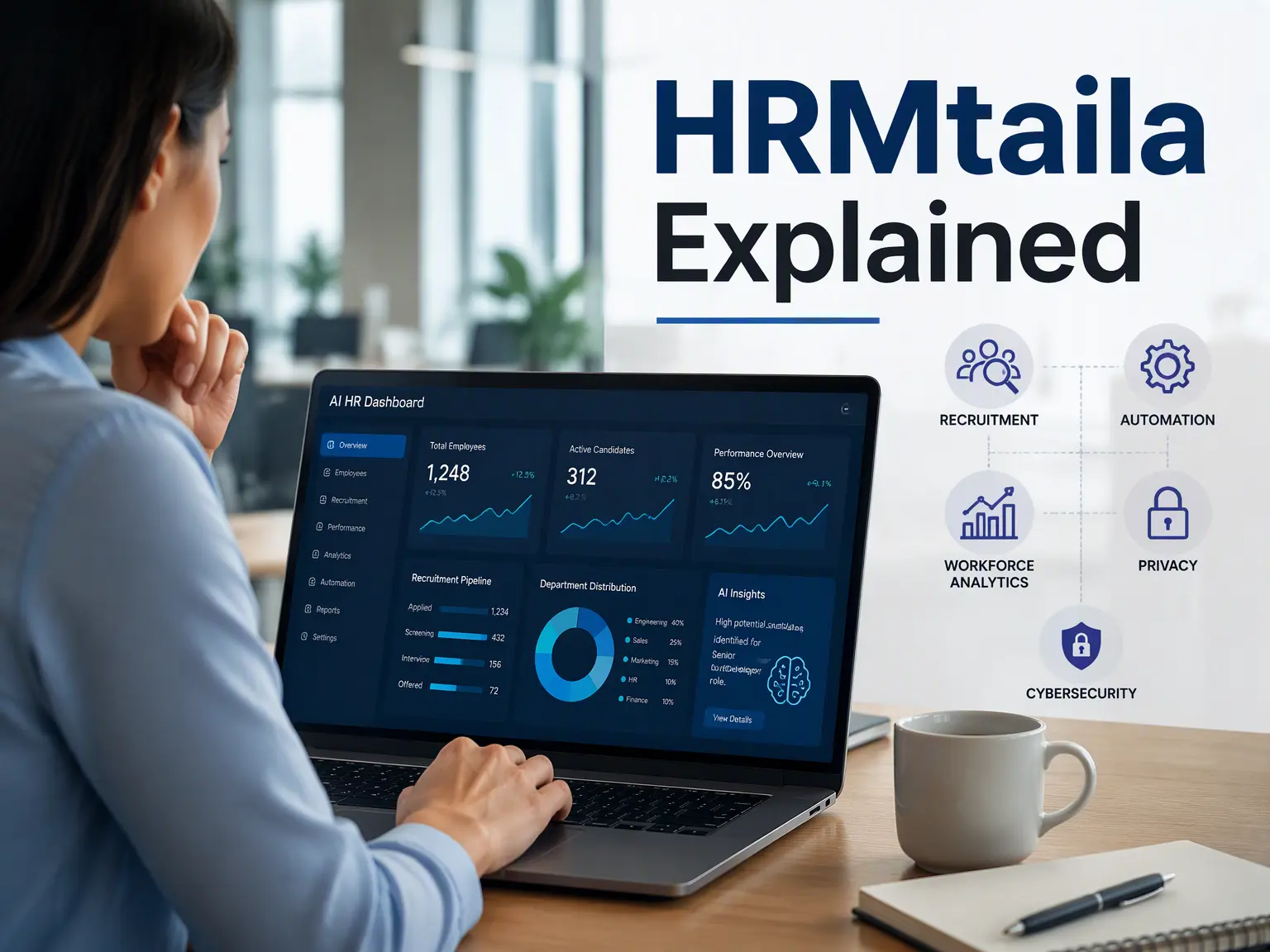
If you have recently searched for HRMtaila, you may have noticed that different websites describe it in slightly different ways. Some connect the term with artificial intelligence, human resource management, automation, recruitment, and workforce analytics.
The important part is that HRMtaila does not currently have a clearly verified identity as a commercial HR software product, company, or recognized HR standard. The available online material mostly presents it as an emerging term associated with AI-powered human resource management.
That distinction matters. It is easy to mistake repeated descriptions across websites for official product information.
This guide explains what HRMtaila appears to mean, how the underlying AI-in-HR concept works, its possible applications, benefits, limitations, privacy concerns, and what businesses should check before trusting a service using the name.
What Is HRMtaila?
HRMtaila is an emerging online term associated with artificial intelligence and human resource management.
The term is commonly discussed in connection with technologies that can help HR teams manage repetitive work, employee information, recruitment, onboarding, workforce data, and employee support.
The HRM portion naturally resembles the abbreviation for Human Resource Management. However, there is no confirmed public source explaining the complete origin or official definition of the word “HRMtaila.”
Current articles generally treat it as a concept rather than a verified commercial product. Trendify Magazine, for example, notes that there is no confirmed developer, company, product history, pricing structure, or official definition behind the name.
So, a useful way to understand HRMtaila is:
An emerging term used online when discussing AI-assisted human resource management and workplace automation.
That description should not be confused with proof that a specific HRMtaila platform provides all of these functions.
Is HRMtaila a Real Software Platform?
There is currently not enough reliable public information to confirm HRMtaila as an established HR software platform.
The available articles do not establish a verified:
- Company behind the product
- Developer or owner
- Official product website
- Founder or executive team
- Product documentation
- Public pricing
- Customer database
- Mobile application
- Software demonstration
- Confirmed integrations
- Product launch history
Several websites now describe HRMtaila in similar terms. But repeated information does not automatically make it official. Websites can copy or expand on descriptions published elsewhere.
This is one of the biggest gaps in existing HRMtaila content: the difference between what is claimed online and what can actually be verified.
For that reason, businesses should avoid treating hypothetical features as confirmed HRMtaila features.
How Does the HRMtaila Concept Work?
Although HRMtaila itself is not clearly verified as a specific platform, the technology associated with the term is easier to understand.
Modern AI-powered HR systems can combine:
- Artificial intelligence
- Machine learning
- HR automation
- Cloud software
- Employee databases
- Workforce analytics
- Digital employee support
- Recruitment technology
A typical workflow might look like this:
Employee data → HR software → AI or automation → analysis or task assistance → human review
For example, an HR system could organize applications, identify skills in resumes, schedule interviews, send onboarding reminders, or answer basic employee questions.
The AI handles repetitive information-processing tasks while HR professionals remain responsible for important decisions.
These are established uses of AI and HR technology in general. They should not be presented as verified capabilities of a specific HRMtaila product.
Potential Uses of AI in HRMtaila
1. Recruitment and Hiring
Recruitment is one of the clearest areas where AI can assist HR teams.
A company might receive hundreds of applications for one position. Software can help organize those applications and identify information such as:
- Skills
- Previous experience
- Education
- Certifications
- Relevant keywords
- Job history
AI can also assist with creating job descriptions, scheduling interviews, sending candidate updates, and organizing recruitment records.
However, an automated result should not automatically become the final hiring decision. A resume may contain valuable experience that software fails to recognize.
The U.S. Equal Employment Opportunity Commission has specifically examined the benefits and potential harms of AI and automated systems in recruitment, hiring, monitoring, and other employment decisions.
2. Employee Onboarding
Onboarding can involve many small tasks.
A new employee may need to:
- Submit documents
- Create accounts
- Read company policies
- Complete training
- Learn about benefits
- Meet team members
- Receive equipment
- Complete required forms
Automation can organize these steps and send reminders when something is incomplete.
An AI assistant could also answer basic questions, such as where to find an employee handbook or how to access training materials.
This can be especially useful for remote teams.
Still, employees should have a clear way to contact a real HR professional when their question is sensitive or complicated.
3. Employee Self-Service
Employees often ask HR similar questions.
Examples include:
- When is payday?
- How do I request leave?
- Where can I find a company policy?
- How do I update my information?
- Where can I find benefits information?
- What training do I need to complete?
An AI-powered HR assistant can potentially answer simple questions quickly.
This reduces repetitive requests and allows HR employees to focus on issues that require personal attention.
However, sensitive matters such as workplace complaints, conflicts, disciplinary issues, or complicated pay problems should not be treated like ordinary chatbot questions.
4. Workforce Analytics
HR departments can collect large amounts of workforce information.
This can include:
- Employee turnover
- Attendance
- Hiring time
- Training
- Skills
- Leave
- Staffing levels
- Labor costs
AI can help process this information and identify patterns.
For example, analytics might show that turnover is higher in one department than another.
That information can help managers ask better questions. But the data alone does not explain why employees are leaving.
Possible reasons could include workload, management, compensation, career opportunities, scheduling, or workplace culture.
This is why workforce analytics should support human investigation rather than replace it.
5. Payroll and Administrative Automation
HR teams often spend considerable time on repetitive administrative work.
Automation can help organize:
- Attendance records
- Leave records
- Overtime
- Employee documents
- Reports
- Payroll information
Connected systems can reduce duplicate data entry and flag missing or unusual information.
But automation does not guarantee accuracy.
A mistake in employee information can affect payroll or other important records. Human checks remain necessary, especially when information affects someone’s pay or employment.
6. Performance Management
Performance management can involve:
- Employee goals
- Project results
- Feedback
- Manager reviews
- Training needs
- Development plans
AI can organize these records and make information easier to review.
For example, an HR system could bring goals, feedback, and project information together before a performance discussion.
But numbers do not tell the complete story.
An employee may be working on an unusually difficult project. Their responsibilities may have changed. A team problem may have affected their results.
Human context is therefore important when using AI for performance management.
Benefits of AI-Assisted HR
If properly designed and managed, AI can offer several practical benefits.
Saves Time
Automation can handle repetitive work such as sorting information, sending reminders, and preparing basic reports.
Improves Access to Information
Employees may get answers to routine questions without waiting for an HR email.
Supports Workforce Planning
Analytics can help HR teams identify patterns in hiring, turnover, skills, and staffing.
Reduces Repetitive Data Entry
Connected systems can move information between HR processes and reduce unnecessary manual work.
Helps HR Teams Focus on People
When routine administrative tasks take less time, HR professionals can spend more time on employee support, development, workplace issues, and strategic work.
These benefits describe AI-powered HR technology broadly, not confirmed features of an HRMtaila product.
HRMtaila Risks and Limitations
AI in HR also comes with real risks.
Inaccurate Results
AI systems can make mistakes or misunderstand information.
A confident-looking answer is not necessarily a correct answer.
Poor Data
If the underlying information is incomplete, outdated, or incorrect, the system’s output may also be unreliable.
Lack of Context
Human situations are often more complicated than the numbers in an HR database.
Over-Automation
Companies may become too dependent on automated recommendations.
NIST’s AI Risk Management Framework emphasizes characteristics such as reliability, security, transparency, explainability, privacy, and management of harmful bias when organizations develop and use AI systems.
Bias and Fairness in AI HR Systems
Bias deserves special attention when AI is used in employment.
Suppose an organization trains an automated hiring system using historical recruitment data. If past decisions contained unfair patterns, an AI system could potentially learn or reproduce those patterns.
Similar concerns can arise in:
- Hiring
- Promotion
- Performance reviews
- Compensation
- Employee monitoring
- Training recommendations
NIST notes that AI bias can arise from different parts of the technology and surrounding processes, and that harmful bias can be amplified by automated systems.
The EEOC has also highlighted civil-rights concerns surrounding automated employment decisions. Its guidance explains that AI and algorithmic tools can create discrimination risks, including disability-related risks.
That means companies should test important HR AI systems instead of assuming that an automated result is automatically fair.
Employee Privacy and Data Security
HR systems can contain highly sensitive information.
Examples include:
- Names and contact information
- Resumes
- Salary information
- Attendance
- Performance records
- Employment history
- Benefits information
- Leave records
Before using an AI HR service, an organization should understand:
- What data the system collects
- Why it needs that data
- Where the information is stored
- Who can access it
- How long it is retained
- Whether information is shared with third parties
- How data is protected
- What happens when an account is closed
NIST’s AI framework includes privacy, security, transparency, accountability, and fairness among important characteristics of trustworthy AI.
What Should Businesses Check Before Using an HRMtaila Service?
Because the identity of HRMtaila is not clearly established, businesses should perform extra verification before providing employee information or paying for a service under that name.
Use this checklist:
1. Verify the Official Company
Look for a legitimate company name, physical business information, leadership information, and reliable contact details.
2. Check Product Documentation
A genuine software product should normally provide clear information about its features and how the service works.
3. Review Privacy Policies
Do not upload employee information before understanding how the data will be handled.
4. Ask About Security
Find out what security controls are available and who can access stored information.
5. Verify Pricing
Be cautious of payment requests that do not provide clear plans, terms, or refund information.
6. Test Before Full Deployment
If a legitimate product is available, test it with non-sensitive information before connecting important employee systems.
7. Keep Human Oversight
Important employment decisions should receive appropriate human review.
HRMtaila vs. Traditional HR Software
| Area | Traditional HR Software | AI-Assisted HR Technology |
| Employee records | Yes | Yes |
| Payroll administration | Common | Can be automated |
| Attendance | Common | Can be analyzed automatically |
| Recruitment | Common | Can assist with screening and organization |
| Employee questions | Often manual | AI assistants can answer routine questions |
| Workforce analytics | Reports and dashboards | AI can identify patterns |
| Human judgment | Important | Still important |
| Automation | Varies | Often a major focus |
This comparison describes the broader HR technology market. It does not confirm that HRMtaila itself offers every feature shown in the table.
What Competitors Missed About HRMtaila
The biggest content gap is not another list of imaginary features.
It is verification.
Many existing articles explain HRMtaila as if it were already an established AI HR platform. Other pages provide long lists of possible capabilities without clearly separating confirmed facts from general examples.
A more useful approach is to separate three things:
What is verified: HRMtaila is currently discussed online as an emerging term associated with AI and HR.
What is plausible: AI can support recruitment, onboarding, employee assistance, analytics, and administrative tasks.
What is unverified: A specific HRMtaila company, developer, pricing model, app, customer base, or official feature list.
This distinction gives readers a much clearer understanding of the topic.
Is HRMtaila Safe to Use?
There is not enough verified information about a specific HRMtaila product to make a product-level safety assessment.
If you encounter a service using this name, check its:
- Official website
- Privacy policy
- Terms of service
- Company information
- Security documentation
- Product demonstration
- Customer support details
- Pricing
- Data-retention policy
Do not upload sensitive employee information simply because a website claims to use AI for HR.
Is HRMtaila Free?
There is no verified public pricing information that establishes an official HRMtaila free plan or paid subscription.
If a website claims to offer HRMtaila for free, check whether it is actually an official provider and review its terms before creating an account or submitting employee data.
Is HRMtaila an AI Tool?
The term is frequently associated with AI-powered human resource management, but that does not prove that HRMtaila is the name of a specific AI tool.
It is more accurate to describe HRMtaila as an emerging online term connected with AI and HR technology unless reliable primary information establishes a specific product.
What Could the Future of HRMtaila Look Like?
The broader field of AI-powered HR is continuing to develop.
Future HR systems may become better at:
- Automating routine administration
- Supporting employee self-service
- Finding workforce patterns
- Personalizing training
- Assisting recruiters
- Connecting HR systems
- Creating reports
- Supporting workforce planning
But better technology does not remove the need for responsible management.
NIST’s framework is designed to help organizations manage AI risks throughout the lifecycle of AI systems, while U.S. employment agencies have highlighted the need to consider discrimination and worker protections when AI is used in employment.
Frequently Asked Questions
What does HRMtaila mean?
HRMtaila is an emerging online term commonly associated with artificial intelligence and human resource management. Its exact official meaning has not been established.
Is HRMtaila a real company?
There is currently not enough reliable public evidence to confirm a specific company behind HRMtaila.
Is HRMtaila an HR software platform?
It has been described online in connection with AI-powered HR management, but there is currently insufficient evidence to confirm a specific established HRMtaila software platform.
Does HRMtaila use AI?
Online descriptions commonly associate HRMtaila with AI, automation, and workforce analytics. However, specific AI features should not be treated as confirmed without information from an official provider.
Can AI replace HR professionals?
AI can automate or assist with repetitive HR tasks, but important employment decisions still require appropriate human oversight and context.
What are the main risks of AI in HR?
Key concerns include inaccurate results, biased outcomes, privacy problems, security issues, poor-quality data, lack of context, and excessive reliance on automation.
Should businesses use HRMtaila?
Businesses should first verify what specific service is being offered under the HRMtaila name. They should check the provider, documentation, privacy practices, security controls, pricing, and customer support before sharing sensitive information.
Final Thoughts
HRMtaila is best understood today as an emerging online term associated with AI-powered human resource management rather than a clearly verified commercial HR platform. Current online discussions connect it with recruitment, onboarding, employee support, workforce analytics, payroll administration, and performance management, but those are broader applications of AI in HR rather than confirmed HRMtaila product features.
The underlying technology is real and can help HR teams reduce repetitive work and analyze workforce information. At the same time, AI should be used carefully because employment data is sensitive and automated decisions can create privacy, fairness, accuracy, and discrimination concerns.
For anyone researching HRMtaila, the most important step is to separate verified information from assumptions. If a specific product eventually becomes officially connected with the name, its company, documentation, pricing, security practices, and product capabilities should provide the evidence needed to evaluate it properly.